After dinner
Body weight and major health events
Appetite opens the conversation. The weight, heart and kidney trials give it different outcomes to consider.
The STEP 1 weight result
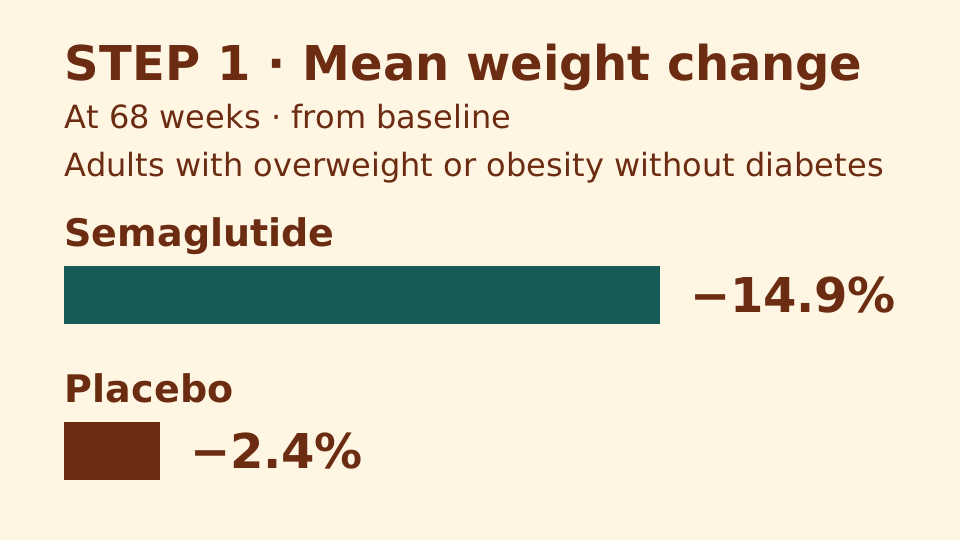
In STEP 1, adults with overweight or obesity without diabetes had a mean body-weight change of −14.9% with semaglutide versus −2.4% with placebo at 68 weeks. The study gave semaglutide by weekly subcutaneous injection at 2.4 mg. That is a description of the trial, not a regimen for a reader.
The separation between the group means is substantial. The gap between those group means needs little embellishment to impress me. It also gives the early drinking finding a useful neighbor: different questions have earned different amounts of evidence.
The chart puts the reported means beside one another. It says nothing about how any participant experienced a meal, and it gives no personal weight-loss forecast.
Heart events in SELECT
In SELECT, 17,604 adults with established cardiovascular disease and overweight or obesity, but without diabetes, had fewer major adverse cardiovascular events with semaglutide than with placebo. The reported relative risk reduction was 20%. The composite outcome grouped cardiovascular death, nonfatal heart attack and nonfatal stroke.
My respect for SELECT rests on the seriousness of its outcome. It addresses serious health events in a defined population. A story about appetite can make a molecule interesting; this trial gives another, very concrete reason to take it seriously.
The population remains attached to the result. These were adults who already had cardiovascular disease. A dinner guest with an unknown health history cannot be assigned the trial's benefit by analogy.
Kidney events in FLOW
In FLOW, involving 3,533 people with type 2 diabetes and chronic kidney disease, semaglutide reduced major kidney-disease events versus placebo. The reported risk reduction was 24%. The outcome included kidney failure, a decline in estimated glomerular filtration rate of at least 50%, or kidney or cardiovascular death. Estimated glomerular filtration rate is a measure of kidney filtration.
Kidney events in people who had both diabetes and chronic kidney disease give this result its particular force for me. Moving from dinner to this trial changes the population, the outcome and the weight of the question.
The small alcohol experiment remains an intriguing opening. The heart and kidney trials provide reasons for interest that reach well beyond the imagined evening, while leaving its question about wanting another drink to the studies that actually measured drinking.